

 5 Min Read
That dull throb at the very back of your jaw. The kind that gets worse when you try to open your mouth wide, or chew on that side at all. If this sounds familiar, chances are it is your wisdom teeth acting up, and you would not be the first person this month to walk into our clinic saying almost exactly this.
Wisdom teeth are strange. They show up late, often when there is barely any room left for them, and then cause more drama than every other tooth combined. Let us get into why that happens and what removal actually involves, without the scary internet stories.
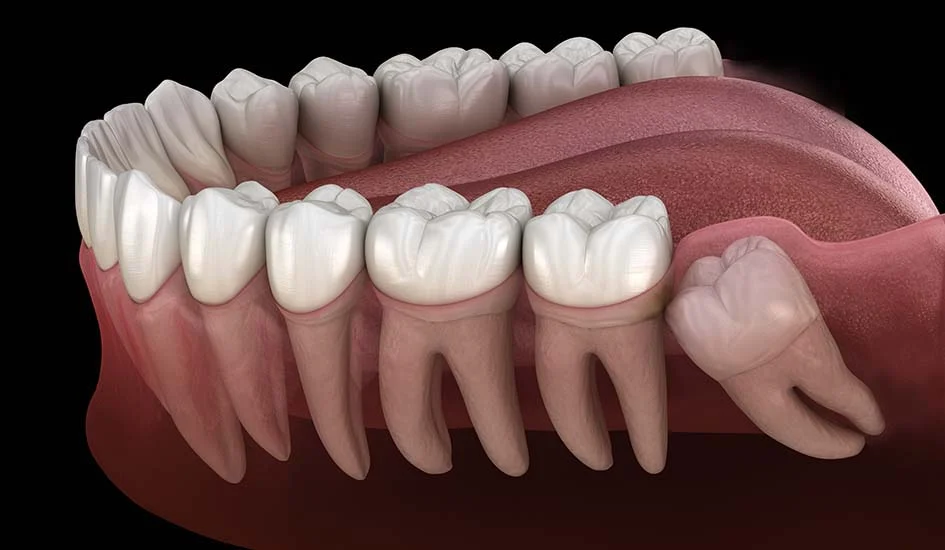
They are your third and final set of molars. Most people get four of them, one in each back corner, arriving somewhere in the late teens to mid twenties. By that age, the jaw has usually stopped growing, so there is often just not enough space. That mismatch is where most of the trouble begins.
Sometimes a wisdom tooth cannot fully push through. It gets blocked, by another tooth, by bone, by gum tissue, and grows sideways or gets stuck halfway. Dentists call this impaction, and it is honestly the single biggest reason people end up needing extraction.
There is also the infection angle. A tooth that only partly breaks through leaves a little flap of gum where food and bacteria love to hide. That leads to swelling, a bad taste that will not go away, and sometimes real pain near the jaw hinge. Even a wisdom tooth that comes in perfectly straight can still crowd the teeth next to it, quietly shifting your whole bite over months.
If two or three of these sound familiar, do not just wait it out. Get an X-ray. It shows exactly what is going on under the gum, which honestly cannot be guessed from the outside.
First comes the X-ray, which tells your dentist how the tooth is angled, where the roots sit, and how close everything is to nearby nerves. That decides whether this is a straightforward pull or something a bit more involved.
Then local anesthesia, which fully numbs the area before anything begins. You are awake through it, but pain is not really part of the equation, maybe some pressure, nothing sharp.
If the tooth has already come through, removal tends to be quick, not too different from any other extraction. Impacted teeth take a little more work, sometimes a small incision in the gum, occasionally a bit of bone needs shifting, and every now and then the tooth gets split into sections just to make it easier to lift out. A few stitches might follow, depending on how involved things got, and then gauze to bite on so bleeding stops and healing can start.
Not during the procedure, that is what the anesthesia is for. You might feel pressure, some tugging, nothing that counts as pain. Once the numbness fades though, expect a few days of soreness. Nothing unmanageable, especially with the medication your dentist sends you home with.
The first day matters most. Keep gauze on the site and change it as instructed. Ice on the outside of your cheek keeps swelling in check. Skip the straw, skip forceful rinsing or spitting, all of that can knock loose the clot that is trying to heal things underneath. Soft, cool food only, yogurt works, khichdi works, anything that does not need real chewing.
Swelling usually peaks around day two or three and then starts fading. Most people feel like themselves again within a week, though the gum tissue keeps healing quietly for a couple more weeks after that. Avoid smoking during this window, it slows everything down noticeably. Keep away from hard or spicy food, brush gently near the site, and actually finish whatever medication was prescribed, do not stop early just because it feels fine.
| Factor | Simple Extraction | Surgical Extraction |
|---|---|---|
| Tooth position | Fully erupted | Impacted or partially erupted |
| Time needed | Shorter | Longer |
| Stitches | Rarely | Usually |
| Recovery | A few days | Up to two weeks |
| Discomfort | Mild | Moderate |
Most wisdom tooth trouble can wait for your appointment. Not these though. Swelling spreading toward your face or neck. Trouble swallowing or breathing. A fever showing up alongside jaw pain. Bleeding that pressure just will not stop. Rare, but if any of this happens, skip the wait and get seen right away.
No, not always. A wisdom tooth that has come in straight and is not causing trouble might just get monitored instead. An X-ray tells your dentist which category yours falls into.
The procedure itself, no, thanks to anesthesia. The days after can be sore, but that is manageable and expected, not the horror stories you might have heard.
A week, roughly, for most people. Full healing of the gum underneath takes a bit longer, closer to a few weeks.
Not right away. Soft foods for the first few days, then a gradual return to your usual diet as things settle.
It rarely resolves on its own. Infection, damage to the tooth beside it, cysts, crowding, all possible outcomes. Worth getting checked even if it is not hurting right now.
Wisdom tooth trouble tends to get worse, not better, the longer it is ignored. If your jaw has been bothering you for a while now, getting it looked at sooner usually means an easier, simpler extraction later.
Book a consultation with Ishtaa Dental in Shilaj or South Bopal and get your wisdom teeth checked properly.